Every rebate a Vancouver homeowner can get in 2026 — heat pumps, solar, insulation, water heaters, EV chargers, and free income-qualified programs — explained plainly, with how each one works.
Updated July 2026 · Independent guide. We don't sell your info. Numbers below are money you keep (rebates), not loans.
Planning a heat pump installation in Vancouver, or just trying to make your home more energy efficient? This page covers every energy rebate in Vancouver in one place, then matches you with a vetted local installer.
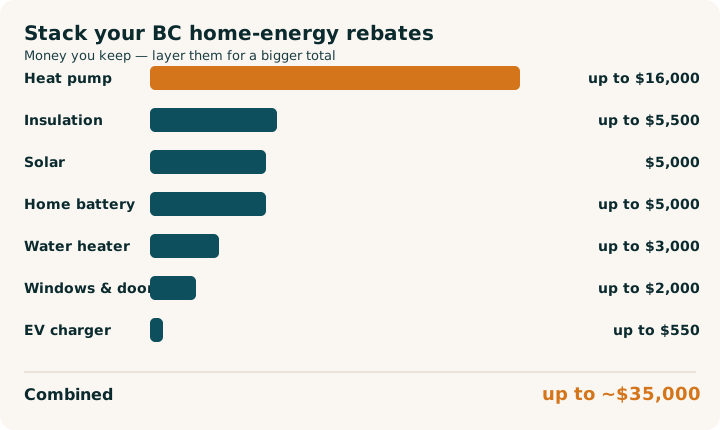
In 2026, a Vancouver homeowner can claim up to $13,000 for a heat pump, $5,000 for solar panels, up to $5,500 for insulation, $1,000–$3,000 for a heat-pump water heater, and up to $550 for an EV charger. Stacked together, the rebates can total roughly $35,000.
Vancouver runs on BC Hydro electricity and FortisBC gas. It's also one of the few BC cities that adds its own money on top of the provincial rebates — so you stack CleanBC, both utilities, the City's top-up, and federal money for lower-income households.
Replaces a gas furnace or electric baseboards. Income-qualified reaches up to $13,000 — an electrical panel upgrade can push this higher (ask your installer for the current combined ceiling) — and Vancouver adds up to $2,000 more (below).
Source: CleanBC / BetterHomes BC
BC Hydro rebate. Roughly 11–14 year payback in Vancouver after the rebate, faster as rates rise.
Source: BC Hydro self-generation rebate
Up to $1,500 paired with solar, or up to $5,000 when enrolled in BC Hydro's Peak Saver program — and it keeps the lights on during outages. A standalone battery with neither solar nor Peak Saver enrollment isn't eligible for a rebate at all, so enroll in Peak Saver within 14 days of install.
Source: BC Hydro / Peak Saver
Attic, walls, crawlspace. Usually the best first dollar you spend — it makes the heat pump smaller and cheaper.
Source: CleanBC / BetterHomes BC
Replaces a gas or electric tank. Amount depends on your utility and income.
Source: CleanBC / BetterHomes BC
ENERGY STAR windows and exterior doors that replace older, draftier units.
Source: CleanBC / BetterHomes BC
$350 for a home Level 2 charger, plus $200 for a power-management device that avoids a panel upgrade.
Source: BC Hydro
Free for electric-baseboard homes starting fall 2026 (a ~$350 value), or $10–$200 in-store rebates on efficient models elsewhere. Peak Saver enrollment adds $100 + $50/season.
Source: BC Hydro / Peak Saver
Browse the full installer directory → for more Vancouver options.
See also: why quotes vary so much → and red flags to watch for →.
If your gas furnace is aging, the rebate math favors a heat pump. You'll claim $4,000–$13,000 (depending on income), plus local financing when available. Total rebate + financing can cover 50–70% of a new heat pump system—and you gain cooling, better resilience, and lower bills.
Quick Win
Replacing a fridge, washer, or dryer? BC Hydro's instant rebate refunds up to $150 per appliance on Energy Star models (dishwashers and cooktops aren't currently included). Window runs through Jan 2, 2026.
See all product rebates →A typical household keeps $5,000–$13,000, plus Vancouver's up-to-$2,000 heat pump top-up. A lower-income deep retrofit can stack toward $27,000–$32,000 in rebates you never repay.
The old federal "Greener Homes" $40,000 grant and loan are both closed as of late 2025. Any site still advertising them is out of date. The federal money that remains flows to lower-income households through the CleanBC programs below.
Two quick questions — free, instant estimate, no sales calls.
Start your assessment →Before You Call an Installer
Get a personalized estimate based on your home and current heating. Includes exact rebate amounts for Vancouver.
Calculate My Savings →Storm-season outages are the real driver here, not the rebate math above (already covered in the grid). A home battery keeps your essentials — fridge, lights, internet, a heat-pump circuit — running when the grid drops. It must be on BC Hydro's approved list or you get $0 for the rebate — the Tesla Powerwall doesn't qualify. Which batteries qualify → Solar's job here is mainly to recharge that battery through the day — at ~3.5 sun hours, think of it as the battery's daytime top-up, not a fast-payback play on its own.
These are the backbone. They're the same whether you're in Vancouver or anywhere else in BC — what changes is which utility runs them for you. Here's each program and how it works.
The centrepiece. A cold-climate heat pump both heats and cools your home using electricity instead of gas. Everyone gets a base rebate; lower- and middle-income households get much more.
Up to $5,500 for insulation (attic, walls, crawlspace) and up to $2,000 for ENERGY STAR windows and exterior doors. This is the "building envelope" — sealing the house before you size heating. See our full insulation rebates breakdown →
A heat pump water heater uses ~⅓ the energy of a standard electric tank. Replaces gas, electric, or oil tanks.
A rebate toward rooftop solar. Excess power you generate is credited back on your bill.
50% of cost up to $350 for a Level 2 home charger, plus $200 for an EV power-management device that lets you charge without an expensive panel upgrade.
Homes with electric-baseboard heating can get a free smart thermostat (a ~$350 value) starting fall 2026. At 300+ BC stores, instant in-store rebates knock $10–$200 off efficient products. Comparing models? See Mysa vs. Nest vs. Ecobee →
Once an eligible smart device is installed, enrolling it in Peak Saver pays a one-time bonus plus a reward every winter season — and for a home battery it's what unlocks the higher self-generation rebate.
A box of LED bulbs, a high-efficiency showerhead and other quick wins, mailed to your door to install yourself. Open to income-qualifying households.
The Energy Conservation Assistance Program sends an energy coach to your home and installs upgrades at no cost — which for qualifying homes can include a free heat pump, insulation, weatherization and ventilation.
Since most homes here also have a FortisBC gas account, you can tap Fortis rebates too: up to $4,000 for a heat pump ($1,500 partial), or up to $12,000 income-qualified, plus $5,000 for a dual-fuel (heat pump + high-efficiency gas furnace) system.
The replacement for the closed Greener Homes grant/loan. An $800M federal program for low-to-median income households, delivered in BC through the provincial CleanBC channels — covering insulation, heat pumps, windows and solar.
The heat pump rebate isn't one number — it scales with household income. These are the general CleanBC tiers; your exact amount is confirmed by the EnerGuide evaluation. The assessment tool estimates your tier in a minute.
Highest support
Plus possible free-install (ECAP) and federal Affordability top-ups.
Enhanced support
Sliding scale between the standard and lower-income amounts.
No income test
Every eligible BC household gets at least this for a qualifying heat pump.
BC Hydro (electricity) + FortisBC (gas)
~3.5 peak sun hours/day
Typical of the coast. Cloudy winters, productive summers — the annual math still works with the $5,000 rebate.
Mostly natural gas
Lots of older gas-heated homes — prime candidates for fuel-switching rebates.
Very reliable
Dense urban grid, generally reliable with occasional winter windstorm outages.
Vancouver is one of the few BC cities that puts in its own money: the City matches the provincial heat pump incentive with up to an extra $2,000, on top of everything CleanBC and your utilities pay. It also publishes detailed green home retrofit guidance and a dedicated heat pump resource for detached homes.
Solar equipment is also exempt from the 7% provincial sales tax, and your excess generation is credited at 10¢/kWh.
Quote to installation: 8–12 weeks for solar, faster for a straight heat pump swap
Permits: City building permit + TSBC electrical permit
Interconnection (solar): 4–8 weeks
Rebate payout: typically 30–45 days after the paperwork is filed
Yes, though Vancouver's ~3.5 peak sun hours are on the lower side thanks to cloudy winters. Summers are productive, and across a full year an 8–10 kW system still offsets a solid share of your bill — helped by the $5,000 rebate, PST exemption, and 10¢/kWh export credit.
An 8 kW system usually runs $25,000–$30,000 before rebates. After the $5,000 BC Hydro rebate (and PST exemption) your net is roughly $19,000–$24,000, paying back in about 11–14 years.
Vancouver's many older gas-heated homes are prime candidates: CleanBC pays $4,000–$13,000, and the City adds up to $2,000 more. You also gain cooling for increasingly hot summers — a genuine health benefit in a heat dome.
The Energy Conservation Assistance Program can install a heat pump, insulation and weatherization for free, and the federal Affordability money flows through it. A family of four earning up to about $57,200 can qualify. Start with the assessment or ask us and we'll point you to the income-qualified stream.
Renters can't claim the structural rebates (your landlord would), but the free energy-saving kit and smart-thermostat offers are open to you. In a condo, in-unit upgrades like a heat pump water heater or windows may qualify with your building's approval; whole-building work goes through the condo board and a separate multi-unit program. See the full breakdown below.
Get quotes now and apply as soon as you've chosen an installer — the pre-upgrade evaluation has to happen before work starts, so late applications forfeit the rebate.
Rebates take a few weeks to line up. These cost little or nothing and start saving immediately — the dollar figures are BC Hydro's own estimates. See all of them in our full guide →
Door sweeps (~$9) and foam outlet gaskets (~$1 each) stop the leaks that make your heating work overtime. How-to →
Turning heat off in empty rooms automatically can save about $150 a year. A smart thermostat that drops to 16°C when you're out saves ~$55/yr. Smart devices →
Shift EV charging, laundry and the dishwasher to 11 p.m.–7 a.m. and avoid the 4–9 p.m. peak. Best for EV owners. See the rate →
Open south-facing blinds on winter days for free heat; close them at night to keep it in. Reverse in summer. Seasonal tips →
Wash in cold water, run full loads only, and insulate exposed hot-water pipes. Small habits, steady savings.
Replace filters yearly, hold a steady temperature, and use "heat"/"cool" not "auto." New to heat pumps? Read our explainer →
Most rebate dollar figures on this page assume you own a detached or duplex home and control the whole building. That's not most of Vancouver. Here's what changes if you rent or live in a condo:
You can't claim the structural rebates (heat pump, insulation, windows, solar) — those go to whoever owns the property. What's actually open to you: the free BC Hydro energy-saving kit (LED bulbs, showerhead) and the free/discounted smart thermostat offer, both above. If you want the bigger upgrades, the ask has to go to your landlord — point them to this page.
In-unit upgrades you control yourself — a heat pump water heater, in-suite windows, an in-unit heat pump — may qualify for the rebates above with your building's approval (usually required for anything touching shared systems or the outside walls). Get that approval in writing before applying; BetterHomes BC requires proof the work was authorized.
Heat pumps, insulation, and solar for the whole building go through the condo board as a group decision, using a separate multi-unit rebate stream rather than the single-family numbers on this page — the per-unit amounts and process differ. Your condo board or property manager applies, not individual owners. The BetterHomes BC energy coach line can walk your condo board through the multi-unit program specifically.
Real retrofit talk from locals on r/vancouver — search "heat pump" or "solar."
City of Vancouver heat pump & permits for solar and heat pump installs. Your installer usually files these for you.
The BetterHomes BC energy coach line answers rebate questions for free, province-wide.
A few guides that go further into topics on this page, for when you want more than the summary.
Tell us what you're interested in, pick a few local installers, and get quotes sent to all of them at once — no sales calls, no obligation.
Loading…
Already installed in Vancouver? Share what you paid — no booking through us required — and help build a real picture for your neighbours.
Share your cost →Every Friday: what I'm learning about rebates across every province and state we cover, heat pump reality checks, solar economics, and the installers I trust. Real stuff, no marketing.